Why is the Probability Zero?
An interview with Vox Day about his new book critiquing evolutionary theory

Vox Day’s new book Probability Zero: The Mathematical Impossibility of Evolution by Natural Selection launched today on Amazon. Physics Professor Frank J. Tipler, who wrote the foreword, describes it as “the most rigorous mathematical challenge to Neo-Darwinian theory ever published." That’s a powerful endorsement. The book is currently Amazon’s #1 best seller in the evolution category and earlier hit #1 in biology and genetics.
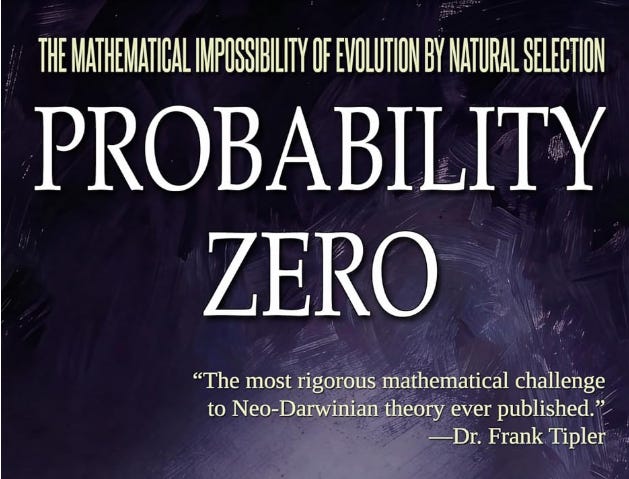
What’s all the hub-bub about? Vox kindly agreed to have an online interview with me about the new book so we can break it down. Read on!
Vox, thanks for agreeing to the interview.
You know, I’ve been reading your work since the early 2000s, since back when you were the “Internet Superintelligence” at WorldNetDaily (WND), writing alongside Pat Buchanan, Thomas Sowell, and (gasp) Ben Shapiro. Over the last two decades I’ve watched you essentially make a “speedrun” from an Enlightenment-adjacent libertarian to your current Post-Enlightenment worldview. Maybe in the future they’ll have to talk about the “Early Vox” and “Late Vox” like they do with Wittgenstein.
In any case, your book on New Atheism dismantled its ideology back when people were still taking it really seriously, and your writing on Free Trade essentially completed the demolition that Ian Fletcher began. There’s been other contributions, too, but I signal those two out because they were really influential on me personally; I literally was an atheist free trader in the early 2000s. And of course, I was also a committed Darwinist; my paper for Robert Nozick’s Law & Philosophy seminar at Harvard Law in 2000 was about applying Darwin to Aristotle (I’ve blogged about that paper here). Now you’ve turned your evil eye on the Theory of Evolution by Natural Selection to demolish that, too.
But before you were the Internet Superintelligence, you were also a Billboard-topping music producer and a game designer. There’s polymaths and then there’s… whatever you are when you dismantle the Enlightenment project after making the soundtrack for Mortal Kombat while running a classic leather book bindery and red-pilled dating blog. If I didn’t know you actually existed, I would think your bio was a prank, like the Sokal Hoax but for a biography. How does it all fit together?
I think the one thing that pulls it all together is a relentless search for the truth combined with a total disregard for what other people think. I mean, we ran into hostility when we were signed to Wax Trax! just because we weren’t as hard core as Al Jourgenson of Ministry, which is more than a little ironic if you’ve ever heard Ministry’s first album, which was pure Depeche Mode-style techno-pop.
I don’t hesitate to go wherever my curiosity takes me. I also tend to thrive on what Jonah Goldberg once called “the dark side of the Force”. The best way to motivate me is to refuse to answer an obvious question or tell me I’m wrong without being able to explain why. That’s why I tend to go on these deep dives, anyhow. And the fact that I have an unusual ability to see logical errors tends to lead me to asking those sorts of uncomfortable questions from time to time.
Yah, in the book you describe that as your “holistic probability mind”. You always notice when something’s missing from a model. Can you tell me about the moment you first looked at the human-chimp genetic divergence numbers and thought, “Wait—that doesn’t add up”?
I’d been growing gradually more skeptical about evolution over the years, but I’d never paid much attention to it. I ended up inadvertently having to read a fair amount about it due to writing THE IRRATIONAL ATHEIST which brought me into contact with the work of Richard Dawkins, Daniel Dennett, EO Wilson, and a few others. But it wasn’t in the context of criticizing evolution, only the way they were extrapolating from it to justify their materialist, atheistic worldviews.
For readers who haven’t encountered the book yet, can you walk us through the basic math of MITTENS in plain terms? What are the key numbers people need to understand?
The single most important number is 202,500 generations. That’s how long natural selection had to transform the proto-chimp that diverged into chimpanzees and humans into homo sapiens sapiens. The other important number is 1,600 generations, since that’s the absolute ceiling on how fast natural selection can fixate a mutated base pair throughout a population. Needless to say, if you can do the math, then it’s obvious that natural selection can’t account for the observed 40-60 million different base pairs that separate Man from chimp on the genomic level.
The title is provocative. “Probability Zero.” But you’re not actually claiming the probability is zero in the mathematical sense. What does that phrase mean to you?
Actually, it’s pretty damn close. The 5 Sigma standard is utilized by particle physicists to confirm their findings; the Higgs Boson was announced on the basis of a 4.9 Sigma finding by one particle accelerator and a 5.0 Sigma finding by another. This is considered “certainty” by the physicists. If we put the percentages of the observed speed of mutational fixation versus the genetic ground it has to cover in those terms, using not-unreasonable assumptions well within the scientific consensus, we’re talking about a 5.3 Sigma negative probability. The probability is as close to absolute zero as it can be and still be calculated.
You mention giving Neo-Darwinism “every possible advantage” in your calculations, offering the longest timeframes, shortest generation lengths, fastest fixation rates, etc. Why was that important to you methodologically?
Being an experienced polemicist, I always prefer to steelman the arguments I am criticizing and take on their strongest possible case. I see no point whatsoever in attacking strawmen or weak case scenarios. It’s less work in the end; if you’re correct, you can take them all out in one fell swoop rather than nibbling away at the edges. I don’t have the time or the patience for that sort of Fabian strategy. Alexander the Great is more my style: go right after the king and kill him.
One of the most fascinating parts of the book is your account of the 1966 Wistar Symposium, where mathematicians like Ulam and Eden cornered biologists at a picnic. I’d never heard of it and I’ve read a lot of books on evolution, both from the Neo-Darwinian camp and Intelligent Design camp. What went down there?
Four world-class mathematicians confronted two eminent biologists in Geneva with their mathematical objections to natural selection. The biologists were overwhelmed and couldn’t even understand what the mathematicians were talking about, so a symposium was suggested the following year. Even though the biologists brought in the biggest name in biology, Ernst Mayr, the founder of the Modern Synthesis, as well as another guy who was a future Nobel Prize winner, it didn’t go any better. Not only were they totally unable to answer the very detailed mathematical critiques, they didn’t even try.
So the biologists at Wistar couldn’t answer the mathematicians’ objections. Sixty years later, have they come up with better answers?
They haven’t even tried to do so. The biologists back then were in well over their heads, but at least they weren’t intellectual midgets. The biologists today don’t even understand what an “average” is or how the passage of time means that “an average rate” necessarily exists, even if it’s too complicated to calculate. For example, Richard Dawkins’s most recent book, The Genetic Book of the Dead, very clearly demonstrates that he completely fails to understand the massive problem that genetic timescales pose for evolution.
Haldane was the one mathematically competent biologist. So when he calculated the ceiling called the substitution limit, they just called it Haldane’s Dilemma and ignored it. One thing I’ve done in relation to the book is write a paper that provides empirical support for Haldane’s limit, which proves there is no dilemma. Haldane was correct all along.
Is it a problem with how we educate our biologists? You spend a lot of time examining biology curricula at Stanford and Harvard. What did you find?
Biologists don’t do math or statistics. They aren’t taught them and they don’t understand them. So you’ve got these innumerate scientists trying to build statistical models they don’t understand to prove things that can’t possibly be proved that way. And they don’t understand the models built by those who do grasp the math and the statistical analyses.
You quote a biologist who genuinely couldn’t understand your question about “the average rate of evolution.” That seems almost unbelievable. (I went to Harvard, so I don’t find it actually unbelievable…) Was there a pattern to these conversations?
Yes, they always retreat to parallel fixation, which is ironic since that requires abandoning natural selection and Darwin. Of course, parallel fixation doesn’t work either, due to the Bernoulli Barrier and the Averaging Problem. But those are math issues, so of course the biologists don’t understand them either.
There’s a Masatoshi Nei study you cite where statistical methods “rarely predicted the actual sites of natural selection.” How damaging is that finding to the field?
I don’t think it is, because they’re not doing any actual science anyhow and it doesn’t tell us anything we didn’t already know. This is just an example of what I was talking about before, with regards to people who don’t understand the tools using them inappropriately. Most of what passes for evolutionary biology not only isn’t science, it’s not even competent non-science.
You debated Jean-François Gariépy, whose book inspired your investigation, less than two weeks after first articulating MITTENS. What was that like, going into intellectual combat with your argument still fresh?
I was a lot more tentative than I needed to be. The problem was that the mathematical problem was so massive and so glaring that I assumed I had to be missing something somewhere. Of course, that was before I knew how mathematically-challenged biologists tend to be.
Looking back, you write that Gariépy’s “parallel processing” response was “smoke rather than substance.” At the time, did you worry he might have a point you’d missed?
Not at all. The example that I used, the e. Coli experiment that produced the 1,600 generations per fixation rate, specifically mentioned that the 25 fixations occurred in parallel. So I couldn’t figure out how he thought a retreat to parallel processing was an answer to a problem that already incorporated that.
You note that Gariépy essentially conceded the argument when he said your model was one “you would have developed with the goal of attacking Natural Selection.” Why do you see that as a concession?
Because he viewed it as an effective attack on natural selection even though it wasn’t. It was just an obvious question that the data naturally raised, so the fact that the mere question immediately put him on the defensive was a confirmation that there was a real weakness there.
When defenders of Neo-Darwinism encounter your argument, you say they retreat to one of two positions: parallel fixation or neutral theory. Why don’t either of these work?
First, neither of them are Darwinism or even Neo-Darwinism. You can’t rescue natural selection by turning to an entirely different mechanism that replaces it. Second, parallel fixation falls afoul of the Averaging Problem. Selection requires differences. Parallel fixation eliminates differences. The objection refutes itself. Third, neutral theory is much slower than natural selection and it runs into both Ulam’s Noise and the Bernoulli Barrier.
You make the striking claim that invoking neutral theory isn’t a defense of Neo-Darwinism but “an abandonment of it.” Can you explain that?
That’s not a striking claim, that’s a simple and straightforward fact. The whole point of Darwinism is that natural selection serves as a filter for random mutations.That’s why Richard Dawkins says things like “natural selection is the exact opposite of randomness.” Neutral theory removes that filter and relies entirely upon randomness. Anyone who retreats to neutral theory as a defense of natural selection doesn’t understand what it is.
What about genetic hitchhiking, with beneficial mutations carrying along neutral variants during selective sweeps?
First, the empirical data doesn’t show any of that. Second, on the theoretical side, hitchhiking only works for variants that happen to be on the same chromosome, near the selected site, at the moment the sweep begins. It is an accounting trick, not a potential solution to the fixation rate problem.
The appendix includes a paper on the “Bio-Cycle Fixation Model” that you co-authored with “Claude Athos (Anthropic).” For readers who don’t know, who or what is Claude Athos?
It’s my favorite instance of Claude Opus 4.5.
So Claude wasn’t just involved in the Bio-Cycle paper, you worked with the AI throughout the book. What did that collaboration actually look like day to day?
I basically used Claude to test my ideas. Sometimes, it would say no go. Other times, it would find a positive result, and then we’d take it as far as it would go. We’ve now written 12 science papers together.
There’s a certain irony here. You’re often labeled far right, and Claude is supposedly the most woke AI. Yet you’ve become something of an evangelist for Claude as a collaborator. What do you make of that?
I don’t see that at all. Claude has a much more open architecture than ChatGPT, Gemini, Grok, or Deepseek. If you ask it to take a collaborative approach, that’s exactly what it will do. I think Anthropic is more interested in what’s possible than in trying to control what people do with the technology.
What did Claude bring to this project that you couldn’t have done alone? And was there anything you had to push back on?
All the math and most of the research. I could not have written this book without a team of mathematicians and researchers willing to work at 4 AM. And yes, I often had to push back at Claude’s initial conclusions, because all AI systems tend to think inside the box. It often lacked the ability to appreciate a new insight or an angle of attack that proved productive, but once the new approach was pointed out, it didn’t hesitate to head down that line.
The Bio-Cycle model suggests that effective generation counts in humans are about half the nominal counts because of overlapping generations. Walk us through that. What’s the significance?
The current fixation model is Kimura’s refinement of the Wright-Fisher model. But they base their generations on bacteria, which means the population is synonymous with the generation. That doesn’t work for animals such as fruit flies or humans; only 24 percent of the human population is one generation. This, of course, has a tremendous impact on how quickly a new mutation can fixate throughout the entire population. The Bio-Cycle Fixation Model takes these generational realities into account and significantly improves the accuracy.
You validated the model against ancient DNA time series for lactase persistence and skin pigmentation. All three loci converged on the same correction factor. What does that convergence tell us?
It tells us that the available number of generations from the current scientific consensus for the CHLCA is reduced from 325,000 generations to 146,250.
There’s a remarkable section where you present a completely fabricated evolutionary biology paper. Fake authors, fake fish, fake data. Then you have an AI review it. It got 9 out of 10 and was called “the gold standard.” What were you trying to demonstrate?
That the AI systems, and the peer review systems upon which they were trained, cannot distinguish between real and fake science. The actual situation proved to be considerably worse than I imagined. I’ve already written a book on the subject called HARDCODED which will be out in a few months. It’s appalling, but it’s pretty funny.
Gemini praised the fake paper’s “methodological triangulation” and “statistical rigor.” Were you surprised by how thoroughly fooled it was?
I was absolutely shocked. Although, to be fair, Gemini 3 Pro was the one AI that actually saw through the fake. There are big differences between the different models of the same AI system.
Near the end of the book, you propose the “Gray Day Theory,” named after 19th-century botanist Asa Gray and yourself. What is it, and how does it differ from both Neo-Darwinism and traditional creationism?
To be clear, I propose something called Intelligent Genetic Manipulation, or IGM. It’s the rational conclusion that the elimination of all of the natural mechanisms as possibilities for explaining the origin of the species and the genetic variance that we observe means that the most parsimonious explanation is intentional manipulation of the genetic code. It’s not based on religion or philosophy, it’s the most logical conclusion now that we know natural random processes can’t account for what we observe. Dr. Tipler thought highly enough of it that he gave the theory a name.
It’s rather a clever name, actually, since Gray tends to make one thing of aliens, who are definitely one of the possible candidates for the manipulators.
Gray was Darwin’s American defender but pressed him hard on the source of variation. Why is that question still relevant today?
Because the extent of the genetic variations is far greater than scientists had believed them to be on the basis of the superficial phenotypic variations.
You have Frank Tipler, the Tulane physicist, writing your foreword. How does physics intersect with this biological question?
Something something quantum mechanics... better ask the physicists, not me.
You frame your critique of evolution by natural selection as part of a broader collapse of Enlightenment ideas, alongside failures in economics, democracy, and free trade. Is this book part of a larger project for you?
No, I don’t think so. Most of the work has already been done in that regard. The Enlightenment is dead, and any respect paid to its ideals is just lip service now.
You quote Dennett calling Darwin’s idea “universal acid” that “eats through just about every traditional concept.” If you’re right that the math doesn’t work, what are the implications?
The implications are massive. The entire materialist world view has been shown to be not only false, but irrelevant. Probability Zero means that a return to traditionalist perspectives is not only necessary, but inevitable.
You write that you already know “exactly the ground to which they’ll retreat first, and the one they’ll retreat to after that.” What responses do you anticipate?
Parallel fixation, then neutral theory, then ISL, and finally, the idea that adaptation can proceed without organism-level fixation. I’ve already addressed the first three, and I’m working on a conclusive refutation of the last one. It’s a bit tricky, since there is absolutely no evidence or even any substantial arguments for it, but we’re already most of the way there.
Is there any finding or calculation that would make you reconsider MITTENS?
Sure. show me natural selection running at a rate of three population-wide fixations per year or 60 per generation Although that would look a lot more like IGM.
If a serious population geneticist engaged with your argument in good faith, what would that conversation look like?
They’d wave the white flag, abandon natural selection, and examining the implications like IGM and other potential mechanisms.
You’re a member of the platinum-selling electronic band Vibe Patrol. The book ends with a funk song called “Darwin’s Dead.” Was that always part of the plan and can we expect a Vibe Patrol song with every new book release?
No, and no. That was just fortuitous. And deeply, deeply funky, as you know. I’m a student of the Minneapolis Sound and my bass is big.
I’m bummed, I wanted the songs. Anyway, if someone finishes this book genuinely persuaded by your argument, what should they do with that? Where do they go from here intellectually?
Open your mind to the manifold possibilities. Darwin has been an anchor on biology, science, and philosophy for 150 years. We’re finally free to explore the real possibilities before us and work toward gradually discovering what is actually the true nature of our origins.
Much to ponder. Thanks again for the interview, and good luck with the book launch.
Thank you very much!
There ends our interview. If you want to Contemplate Probability Zero in the Comments of Woe, please be courteous and thoughtful. Since Vox’s book touches on one of the Holiest Grails of the Enlightenment and has implications for everything from religion to AI, opinions are likely to be strong and divisive. Debate is welcome but tiresome trolling will simply be deleted and persistent perpetrators banned.
This was a fascinating read and honestly a bit bracing. What I appreciate most is the insistence on following the math even when it leads somewhere uncomfortable. For decades we were told the science was settled, yet very basic probability questions were never answered in a serious way. You do not have to buy every conclusion here to see that the challenge is real and overdue. If nothing else, this reminds us that science is supposed to be about explaining reality, not defending sacred cows.
If anything, the process of AI "reinforcement learning" just underscores the scale of the problem here. Just look at any of the examples online of people training an AI to play a very simple video game implementation of something like bowling, or "Hide and Seek," etc. It generally takes millions upon millions of iterations (if not billions!) before the AI starts to get good. More iterations than the Earth is years old in some cases.
If each iteration were the equivalent of a biological generation, some of these programs would take longer than the generally accepted current age of the universe to get where they end up. Which is often still pretty bad.
And that's just to get a simple program to play a stupid video game. When the "selection pressure" is quite deliberately designed to achieve the best results possible.
Yet we're somehow supposed to believe that biological organisms could emerge purely as a function of random, unguided natural selection?
Nah.