Counter-Spoliating Children's Stories
An interview with Thomas O. Bethlehem, creator of Fables For Young Wolves

When I started blogging here on Substack six years ago, I was at one of the lowest points in my life, and the blog’s name and temperament reflect that. Given the tone and subject matter, I never expected Contemplations on the Tree of Woe to reach 1,000 subscribers, let alone 10,000 subscribers. Yet here we are - there’s thousands of you reading my work.
But I don’t always have something to say, or at least something to say that I think is important enough to write a 3,000-word essay about that I email to 10,000 people. Sometimes I don’t even think my ideas are ready to pitch to my wife, let alone all of you! I didn’t really start Tree of Woe for commercial purposes and I don’t really want to transform it into a trend-chasing blog with constant commentary on the latest events, either. So when I have something I think is important to say, I write that up; and when I don’t, I don’t.
What, then, to do with the dead air in between? What I’ve taken to doing lately is trying to help the cause of counter-spoliation.
Long-time readers will remember that several years ago I penned an article called The Spoliation of Pop Culture. In that article, I explained how America’s progressives had gained control of the arts, entertainment, education, and media industries, and used that control to engage in spoliation: They identified every valuable expression of American culture and repurposed those expressions for their own use.
At the end of the article, I urged people interested in defending our culture to actively wage counter-spoliation. I’ve tried to live up to my own advice. I have written a lot of “pop” entertainment myself (mostly tabletop games and comics) and I have tried to supported the output of other fellow travelers.
One way to help support my fellow creators is by interviewing them. Interviews are something I’ve always enjoyed doing. Years ago (before I was cancelled) I did an interview with game designer Mike Mearls about Dungeons & Dragons that went catastrophically viral. Over the last two years, I’ve been running an interview-format show called ACKS To Grind on my YouTube channel. And, of course, here at Substack I’ve interviewed Hans G. Schantz twice and Vox Day once to help promote their efforts.
Today I’m interviewing Thomas O. Bethlehem, the author of the book Fables For Young Wolves. Fables is “a book for young men in a world that does not want them. It is a collection of fables and parables that explore the meaning and consequences of strength in a harsh and dangerous world.” It was released last August and has an impressive 4.8/5 score on Amazon.

Thomas (whom I’ve known online for many years) kindly agreed to chat. The rest of this article is the interview. My questions are in bold italics while Thomas’s answers are in regular font.
Thomas, there has been a lot of discussion in right-wing circles about the need to re-take our arts and culture. But despite being the party of “family values,” our side doesn’t actually write that many children’s books! Tell us about yours, and what motivated you to write it.
This is a bit pedantic, but if we expand the scope of our side to everything even vaguely rightward, there are actually oodles of children’s books out there... They just suck. Somewhere along the way, publicists and brand managers decided that having a kid’s book was just another part of the Influencer Stack, so every microcelebrity from Jocko Wilink to Matt Walsh has a kid’s book floating around. I like both of those guys for different reasons, but we don’t hear about their kids book because they are, in all likelihood, uninspiring, unoriginal, undifferentiated slop generated by an LLM or some libtard ghost writer.
This is because the goal is expanding the brand and fortifying revenue gains, not telling meaningful stories on which to build character & culture. Families that read bedtime stories are always looking for another board book, uncles and aunts are always looking for another easy birthday gift, and the relentless hucksterism of online markets all contribute to generating more options, faster. If you look at these books being put out by conservatives and conservative organizations, you quickly surmise that there is no passion, no love, no driving need to craft stories or guide young minds. It’s just the compressing and simplifying of whatever message they are already selling into a format that is technically “for kids.”
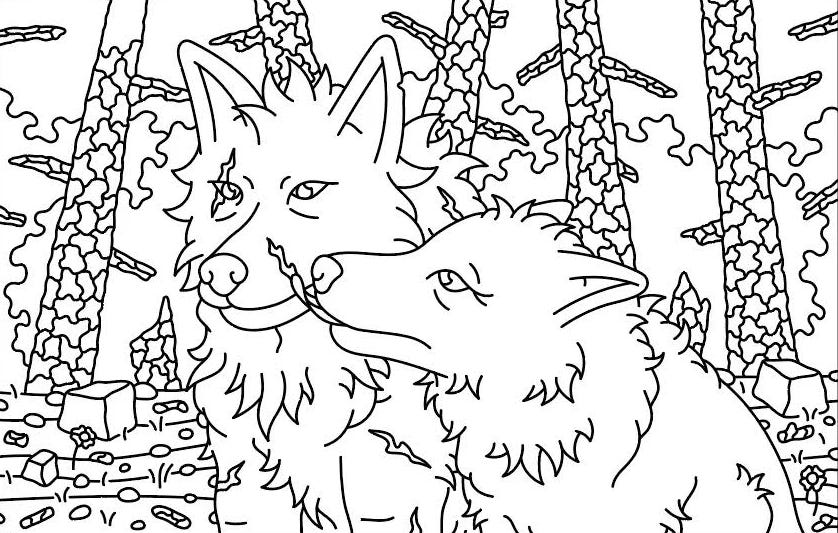
In the case of Fables for Young Wolves, I was divinely inspired to create stories that would serve as guides for my children when it comes to the simple but important questions of who to be, how to carry yourself, and how to identify the vast array of creatures you might encounter. At its core, Fables is a collection of stories for young men in a world that despises them.
Why did you make it a book of beast fables? Nowadays anthropomorphized animals have been claimed by the other side, for the most part. There were a lot of right-leaning beast fables historically, but not lately. Is there a reason for that?
There’s a clip of Neil Postman asserting that the greatest crime of Modernity is the destruction of childhood. He states that children are being groomed into consumers, and the crime against humanity is effected by way of toys filtered through electronic nostalgia and the endless but meaningless delights of the flashing screen. I could not agree more.
Beast fables are timeless because they are quite possibly the most efficient mechanism for the delivery of observable truths. We are hectored into treating every human with the preposterous and artificial concept of “equality,” but we are, thus far, still allowed to notice the innate differences of identity, proclivity, and capacity in animals. Trying to teach young men about the risks and tendencies of a given population or type of person can take months or even years, and you are forced to filter or dance around the truth. But if you talk about animals, you can come right out and say exactly what you mean, and you can do it in a way that is very portable across age cohorts and ethnolinguistic groups.
Right, right. One of the things I often ponder is that anthropomorphized animals go hand in hand with animalized humans, that is, it implicitly suggests that we have something in common in our natures that makes it possible for the lessons of the one to convey to the other. But that is anathema to the views of the leftists who believe in humans as blank slates, without a nature. What do you see as the connection between human nature and animal behavior?
I would go one further and assert that every Occidental imputes the blank slate theory to all humans, regardless of political or ideological identity. It is a mind virus that can accurately be described as endemic. It takes great effort, luck, and time to break a Western mind of this silly habit, and, in my experience, cannot be cured with a single treatment or course of antidotes. It is so easy to slip back into the blank slate mental model, and this ease gives us an indication of how terribly important youth fiction is.
I am of the mind that humans are distinct from animals, that we are not just lucky apes with magic rocks and climate control. At the same time, it is the height of foolishness to disregard the obvious existence of animal nature and tendency in man. In a strange sense, it is our innate difference, maybe distance, from animals that allows us to see them as ourselves, and ourselves as them.
I sometimes find myself jealous of the way animals are so naturally comfortable with simplicity: seek food, seek shelter, seek mates, seek life. They don’t rely on teachers or texts to find themselves, they merely exist and never question it. Man is fallen, and when we surrender to our base nature, awful and pointless things are often the result. But fabricating some kind of humanist pedestal and placing ourselves on the top, like we don’t feel urges or don’t fall into predictable and identifiable modes of being, doesn’t make sense. There is very little I find estimable or compelling from so-called “Native American” cultures, but animal totems make very good sense. Every person you know can be accurately likened to one animal or another, and this likeness extends to both phenotype and spiritual tendency.
The strongest connection between us and beasts is the rigorous and inescapable cage of reality, by which I mean the physical constants of our world. How we engage with these limitations defines who we are and how we are remembered.
That leads to my next question: What type of beast are we? The book is entitled Fables for Young Wolves, and often the protagonist of the story is a wolf. Is there an underlying symbolism that drove you to choose wolves as the identifier for the young reader, as compare to, let’s say, dogs? What does the wolf mean in the context of your fables?
One of my favorite things about biology as we currently understand it is that there’s very little real difference between wolves and dogs. Of course, our meddling in breeding and diet has generated a wide range of detestable and horrific little creatures that have no real place in the animal kingdom, and this crime won’t go unpunished. But for the most part, wolves are just dogs that don’t need people.
In classic beast fables, the wolf was deployed as a dangerous creature because every culture and society proximal to their ranges was well acquainted with their capacity for violence and their collective cunning. Likewise, early dogs were nearly as dangerous, only beholden to man via inducements like food, shelter, and the whip. But this was a world completely ignorant of the placid and listless depths to which men could sink when machines were deployed as an insulating cocoon from the harshness of reality.
I’m not a Luddite. I don’t want to smash the machines and live in a longhouse with a loin cloth and a pan flute. At the same time, I think we have gone too far, similar to those miniscule breeds of of dog that cannot eat, breathe, or breed without constant assistance from their masters.
The wolf represents danger, and the fact of the matter is that men in general, Western men in particular, need to become dangerous again. That danger takes many forms, some less productive than others. But it is painfully obvious to me that the religion of progressivism has put at its forefront the defanging of men. They want us soft, submissive, and sedate. They want us to be lap dogs, and in large part they have gotten exactly what they wanted. It is my earnest hope that I can contribute to a fundamental re-wilding of the Men of the West.
I notice you say “Men” of the West. Did you write the book for kids in general, or for boys specifically? Most fiction today is female-coded and children’s fiction especially so. Are there lessons in this book that are meant for one sex or the other?
Yes. This is a book for boys, and I am confident in the capitalistic aspect of my endeavor precisely because so many of us are still boys stomping around in men’s bodies with torn minds. I consider it no bad thing to have a childlike perspective on Nature and life. But it is all too often the case that we are stuck in some kind of permanent spiritual childhood, always looking for father government to protect and mother society to nurture.
It is my sincere hope that my stories are a useful tool for fathers in the cultivation and instruction of young men, and the feedback I have so far received is very encouraging. I’m not ashamed to say that this book is for boys, but that doesn’t mean there aren’t things in it for girls and women. When it comes to Western Society, no one is doing very well. But there is an immense meta-structure of guidance and support for girls out there. Everyone is ready to hear her side, to adjust things to her sensibilities, to support her aspirations. Fine, all well and good, but I am not a girl, nor are my friends, brothers, or sons. Men need guidance, they always have. The problem I am seeking to address is that not only are men bereft of guidance when they are young, but there is a deluge of deceit and misinformation with the express purpose of sending young men down a path of meekness, feminization, and ease.
If you want to “save women,” the task is actually pretty simple: look to our history, observe what our ancestors did, and do it. Saving men is a much harder task, because the mass feminization of the West is simply unprecedented. The only examples that even come close are all very sad stories of imploding empires and dying societies. If we are to have any hope for tomorrow, then the top priority needs to be making men dangerous again, and that starts with teaching little boys how to take calculated risks and engage with reality on its own terms with the explicit goals of dominating, winning, or surviving.
You said the stories are “useful tools for fathers in the cultivation and instruction of young men.” Let’s discuss that a bit more. A fable, as compared to other types of myth, legend, or story, explicitly aims to teach something. What do your fables aim to teach? And why do you think so many terrible kids books teach them nothing - or worse, teach them bad things?
The vast majority of children’s books and young adult fiction has two primary aims: elevate feminine character and methods, and denigrate masculine modes and methods. You can condense this further into a single goal: soften all edges. I think it’s important that we acknowledge that these aims have been met; men are for the most part soft, and our society has spent trillions of dollars and decades of time removing every possible edge.
Confronting this mess in some kind of totalizing way is a Herculean and, sadly, impossible task. But we can go back to square zero and begin the arduous but necessary process of redefining edges and empowering children to engage with reality as it is.
The book is full of messages, most of them hard earned wisdom from my own life and the many men I have encountered, some great, most broken, all surrounded and under siege. I don’t think there is much utility in trying to give people answers. I think a better path is teaching youngsters how to put together useful questions, questions that blow away smoke, shatter mirrors, and cut reality at the joints.
What often differentiates “masculine modes and methods” from the feminine is physical struggle - fighting, force, violence. What do you see as the place for violence in kid’s and young adult fiction? Is it appropriate or not?
Yes, emphatically yes. Violence is an inescapable aspect of reality, and children need to know this, they need to understand that no amount of nanny methodologies or money spending will make it go away. Kids need to know that violence comes in many forms, has many use cases, and creates many different and variable circumstances and outcomes.
One thing I spend a lot of time thinking about is Force vs Violence. In our current culture, violence done under the color of law is almost always referred to as Force; justified, necessary, etc. This is not a bad thing in and of itself, but the profusion of anarcho-tyranny has created a circumstance wherein naked and pointless violence is not only accepted but encouraged when it is indulged in by certain protected classes, while intentional violence, say, in the defense of a home from a ne’er-do-well or in response to the politically deranged is portrayed as unsavory, immoral, unethical, or unnecessary.
We teach children that when they are confronted with danger or violence, the best thing they can do is hide and dial a number so that the proper and approved wielders of sanctioned force can arrive to dispense justice. Kids see that vandals and hooligans are allowed to destroy anything and damage anyone, but if a normal, healthy person stands up to them, the police go after him. Career criminals are given an endless number of chances by judges and law enforcement, while any man with an education and a job that puts a toe over some imaginary line gets every book in the library thrown at him.
This situation is not accidental, it is intentional. This is the result of decades of instructing children to be meek, weak, and soft. We have a massive infotainment complex to make pliable and submissive consumers. Because our Elites are cowardly or complicit, we have to begin the work of raising a generation of wolves from the creche of lapdogs. And we are going to do that with children’s stories.
Is that possible in today’s work? How does fiction stay meaningful to young people confronted by the dopamine rush of games, movies, and TikTok?
This is depressing, but the honest answer is that it doesn’t. It’s hard to think of anything quite so destructive as putting children on the dopamine drip of personal screen culture. I am thoroughly convinced that future generations will look back on our willingness to give children tablets and teenagers smartphones with the same abject horror we feel when hearing stories of how radium used to be given out as an over-the-counter fixative, or lead being used in water pipes.
I have encountered very few parents who are willing to confront this dilemma head on, always proffering the flaccid excuse of social opprobrium or cultural isolation as to why they are just going along with the hyper-commoditization program. They seem terrified of little Johnny or Jessica not moving in lockstep with the herd. It’s honestly pathetic, and I know this is extreme, but I can’t really consider a parent “good” if they have tablet kids. It is as bad as childhood obesity, though it should be pointed out that fat people can lose weight much easier than screen addicted people can become normal and healthy again.
It is depressing and immense, but I think it is not yet hopeless. One important step is homeschooling, and the last few years have been very encouraging in terms of numbers and results. I could go on a lot longer about this, but I will just point out that every inventor of substance, every leader of skill, every notable name you can come up with before 1900, and quite honestly most afterwards as well, were not educated in facilities but tutored in the home.
For fiction to be as meaningful as we need it to be, we need to do the hard work of coldly and judiciously appraising what types of entertainment and diversion we allow our children to access. In addition, but equally important and in many ways completely separately, we must discriminate against families who are unable or unwilling to care enough about their children to control their diets, both nutritional and memetic. It won’t matter if you cultivate keen and brilliant young minds if you then just corral them with mouth breathing tablet kids. We are living in a time of distributed triage. For my part, I never want to have to explain to my grown up kids why I didn’t love them enough to be discerning about the food they ate, the things they watched, and the company they kept.
Based on how the book has done, do you see an opportunity for the right in the YAF and kid’s market? How would you recommend aspiring creators proceed?
As far as I can tell based on discussions with other authors and articles online, I am doing extremely well for a first time author with no representation and not a penny put towards marketing. I am naturally self-deprecating and I come from a subculture that puts pride and vanity right at the top of the worst sins possible, but the stubborn insistence of my wife and close friends have forced me to acknowledge that the book is actually pretty darn good. It’s a good read and it is a fun read. It’s full of excellent illustrations and great little stories, both sides of that coin being earned through diligence and hard work and, most expensively, time.
In terms of sociopolitical strategy, I cannot fathom why there isn’t an absolute deluge of right wing kids books and YAF. It is the most critical battleground of them all, and the data is hilariously clear: the stuff we read and enjoy as kids and teens defines our perceptions, proclivities, and persuasions for the rest of our lives. I am a sucker for post-apocalyptic fiction, hard sci-fi, deep lore fantasy, and grimdark fare, but all of that is entirely the result of the things I read and watched as a youth. I am incredibly blessed because I grew up without a television in the home in a family where reading was thoroughly emphasized. As well, I’ve never gotten car sick from reading, and my family spent substantial time on the road. Books were everything to me, in many ways they still are. I know that’s atypical, but I have found that the love of literature is not as rare as one might think, at least in terms of the Greater Right.
It would be incredibly presumptuous for me to give any kind of guidance or advice, as I am still very much a newcomer to the world of fiction authorship. I will say that we have to put story over everything. It’s a mistake to start with a political perspective or an ideological aim then shoehorning in a story afterwards. That approach is why everything progressives vomit into the market is trash. We have to put story first because it is the foundation upon which everything else hangs. I’m so thankful lots of people seem willing to buy the book, and I of course hope many more join that crowd. But this entire process had one single goal from the very beginning, and that was seeing the temporarily small hands of my firstborn lifting the cover and leafing the pages.
I accomplished my goal; he loves the book. Everything else is just icing on the cake.
There ends our interview with Mr. Thomas O. Bethlehem. But our foray into Fables For Young Wolves is not yet over!
Thomas has kindly given me two excerpts from Fables to freely share with the audience here at Tree of Woe. The first, “The Wolf and the Lady” is a long fable, while the second, “The Wolf and is Shadow,” is a shorter parable. Click the links below to download them in PDF.
If you enjoy the fables, you can get Thomas’s complete book at Amazon. It’s available in both paperback and hardcover.
As a young boy decades ago, I myself was strongly influenced by a children’s book not unlike Fables For Young Wolves. It was called Mighty Men, written by Eleanor Farjeon in 1975, and chronicled the lives of heroic men ranging from Achilles to Alexander to Hannibal to Beowulf to William the Conqueror. It was one of the greatest gifts my parents ever gave me and I loved it so much that when I became an adult I hunted down an out-of-print copy of the first edition. When I say I think Thomas’s Fables could be equally influential on its young readers, that’s the highest praise I can give it. Contemplate that on the tree of worooooooooooooooooo.
I purchased Fables for Young Wolves for my 11 year old grandson for a Christmas gift. I think he may still be a bit young for some of the stories, and certainly much of the vocabulary is beyond him, though he does like to read and does so daily. I doubt that he’s read it yet, but his dad, my son, commented that he would enjoy reading the stories. I hope he and my grandson are reading it together.
My grandson is like so many with a deep involvement in the digital world. For all the positive ways in which my son and d-i-l are parenting my two grandchildren, I am dismayed that they’ve allowed both to have access, though not unlimited, to smart phones and tablets. They believe they’ve locked down both devices to protect against the many ways evil - doers can gain confidence and access, but even if that’s possible, and I have doubts, just the constant eyes on screens is not doing them any good. I’ve wracked my brain trying to penetrate their disengagement with anything that isn’t a screen, but I’ve failed. Neither he nor my granddaughter, aged 15, will engage in conversation with me beyond cursory responses amounting to little more than a few words.
I read both of the stories you included. The Wolf and the Lady has a dark theme that moms might consider too violent for young readers. I did find it immensely readable, certainly holding my interest. I think a young reader ranging from mid-to late teen, will appreciate the fact that the stories aren’t pandering to them by softening or disguising the hard edges of the message in each story.
When you're hiking, you sometimes take the wrong path or go in the wrong direction and wind up in a mire. You can push on and through, or you can turn back.
No matter the choice - either carries its own costs - the mire will remain and you will need to navigate it somehow, and take into account when you walk on, what to look out for so you do not wind up in another one.
I view the Culture War the same way: going back is a valid choice, but you cannot stop where you went back to - to do so is to yield the scouting position to strangers and randomness. If you go back, you must still forge ahead a new path.