Weeping Tears from Iron
An Interview with Fantasy Author Jonathan Oldenburg

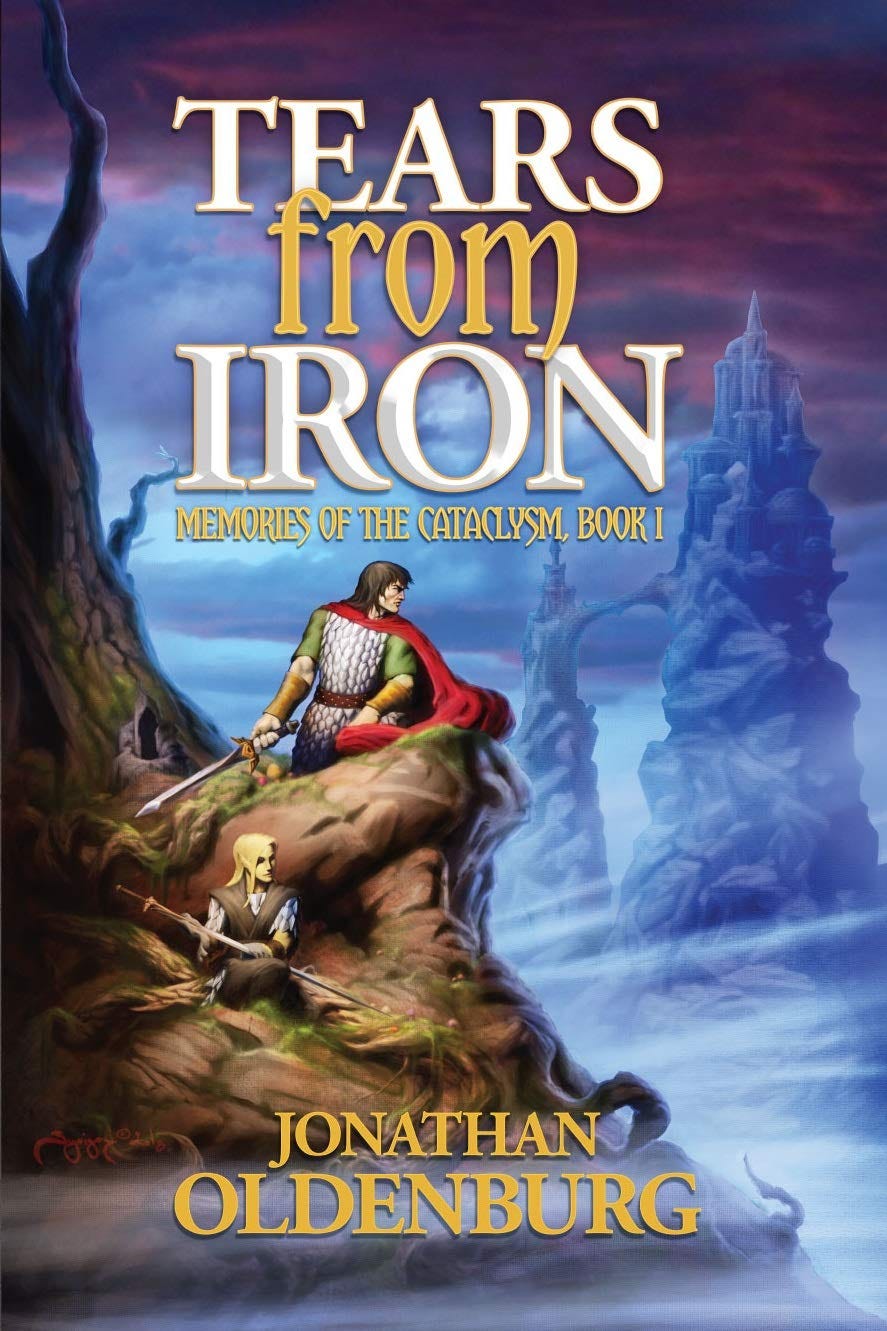
My efforts at counter-spoliation continue. Today I’m delighted to present an interview with one of my oldest friends, author Jonathan Oldenburg. Jonathan and I spent two years at West Point together (1993 - 1995); we remained close friends after I departed. In our 20s, we collaborated on the initial development of a fantasy world called Isfalinis. In the decades since, Jonathan has further developed Isfalinis into a detailed paracosm that serves as the home of his debut novel, Tears from Iron (which my company, Autarch, publishes) as well as its planned sequels.
Given our decades-long personal and professional relationship, I must disavow any pretense of journalistic objectivity (not that I often pretend to much of that). Today you’re really reading a conversation between two old friends who have long enjoyed exploring philosophical and historical topics together. Hopefully you find Jonathan’s thoughts and work as interesting as I do. Let’s get into it!
Jonathan, thanks for taking some time to contemplate things here on the Tree of Woe. Compared to a lot of the people I have interviewed, you are publicly apolitical. Your social media presence focuses on narrative and mythological issues. Do you consider yourself to be engaged in counter-spoliation?
The short answer is “Yes-No,” or perhaps “No-Yes.” I believe that the best route to achievement in anything is found by focusing on the work without being dragged into this or that agenda. Find what you love. Determine what is important. Tell epic adventures in which readers can immerse themselves… and weave in themes that matter.
In terms of politics, you are spot on. Internally, I have opinions as strong or stronger than the next person. But imagine aptitudes as pieces on a chessboard. The bishop is someone gifted with rhetoric while the knight is a visible champion exhorting a cause. But I’m a rook—the best way for me to engage with the world is by example.
This philosophy was baked into me in my early days at West Point. My childhood was somewhat sheltered so, amid the rigorous training of the first summer, I also experienced culture shock. My roommate swore vociferously. Endeavoring to keep my tone as polite and nonconfrontational as possible, I asked if he could cut back a little when I was around. He laughed, told all his friends, and the swearing redoubled. I learned my lesson and never made such an appeal again. Three years later, as graduation loomed on the horizon, some of my friends happened to mention that, knowing my beliefs and respecting me, they had voluntarily reined in their swearing when I was around. I had never said a word on the matter.
That tracks with everything I remember about you from that time. It also tracks with something I read once about leadership style — that introverts do best when they lead by example.
Right. And that’s how I have projected myself ever since. I can’t compel someone else to agree with me. There is no magic phrase to convince them and, the more argumentative I am, the more likely they are to dig in.
Yet am I an agent of counter-spoliation? I think so, though perhaps a better term would be “secret agent.” This is because my beliefs, and therefore my stories, are rooted in elements under attack by this despoiling modern world. I didn’t undertake my authorial journey for this reason. The goal was to write stories I want to read—tales of valiant heroes standing for the harder right over the easier wrong, even if the correct path is not always easy to see. While they are imperfect, they are lights against the darkness of the world. Every victory comes with a price… but that price is always worth paying. In other words, I write tales that deny modern lies and uphold traditional values.
I’ve always considered it this way: The flavor of the month may earn fans in the short-term, but such schlock will soon be relegated, not to the dust heap of history, but to oblivion. Look at J.R.R. Tolkien, though. Did he write to appease the fads of his day? No, he wrote the story he wanted to tell and he wrote it masterfully. And he is still more widely read and popular than the soon-to-be-forgotten modern trend chasers.
The reason I entered the social media space was to bring attention to my novel, Tears from Iron and its upcoming sequel. Yet as I provided commentary on storytelling and worldbuilding, I discovered opportunities to encourage creative souls to think more deeply than modern society wants them to as they engage with the craft.
To my mind, that’s the crux of spoliation. Its poison is based on the suppression of independent thought. Counter-spoliation, therefore, begins by forming breaches in the popular narrative. I’ve assailed that rampart by delving into the truth of slavery as an inspiration behind certain themes of Tears from Iron. I’ve battered the gates by offering worldbuilding advice that decouples modern racial theory and agenda-driven politics from fantasy worlds. But the underlying intention is to help others think for themselves… and so, begin to undo the incalculable harm done to the genre.
Ultimately, I’m not trying to win an election. I’m trying to reach people without shutting them out. To do that, I don’t denounce their beliefs as wrong, I tell stories that show what is right. I do this through the uplifting of nobility and virtue over sloth and selfishness. I show that we don’t live in a GrimDark world, but rather a universe where God has already won. The struggle is real and life is pain, but we’ve read the last page and know how it all will end. The choice before us is what to do with that perfect hope. Fortunately, God has allotted each of us time to figure it out.
OK, let’s talk about God a bit. There has been something of a Christian awakening among men today, but you were already a devout Christian when I met you 30 years ago. In the time since, I don’t think I’ve seen your faith waver despite some serious hardship. As a Christian, how do you view your work as an author? Do you agree with Tolkien that there is something sacred (for lack of a better word) about secondary creation? Do you feel obligated to spread the Gospel in some way in your work?
These are, in most ways, two distinct questions that interrelate only loosely. The first is a personal journey of discovery and worship. The second is an external journey of saving others.
I fundamentally agree with Tolkien. As I’ve developed my fantastical world of Isfalinis, including its geology, history, peoples, and cultures, I’ve been struck repeatedly by the profound wisdom and power of God. I’ve realized that all of my endeavors are like that of a child mimicking the great master of this universe. In my worldbuilding efforts, I catch glimpses into God’s creation and love for us. I love the world I have made and sometimes can’t help but shed a tear at the torments I put my fictional characters through… and God has done it all for us in reality.
As for the second question concerning a desire to spread the Gospel, the answer here is also yes—albeit a very careful one. I say careful because there are two very important nuances here. First, setting aside Christianity or any other theme, there is one absolute truth that should be foundational for every author. The most critical element of any story is that it is interesting. I realize that some will disagree with this. I’ll just avoid their books.
Second, I do not write Christian stories, rather I am a Christian who writes stories. The difference here is huge. If I was the former, my goal would be to publish for Christian book stores to a Christian audience. I don’t deny that there can be value here; it simply holds no interest for me. Indeed, I find Christian fiction to be boring (the “Chronicles of Narnia” being a solitary exception). I do not like fiction that is written FOR anything, even ideas I hold dear.
To build a C.S. Lewis versus J.R.R. Tolkien analogy, I am fully ensconced in the latter’s path. As a Christian, it is inevitable that my beliefs will inform characters, plot, setting, and theme but these are subtle influences. A reader might guess that I’m a Christian after reading “Tears from Iron,” but they probably won’t be certain and, far more importantly, they will not feel preached at.
Nevertheless, I do feel a need to spread the Gospel in my work and this desire has increased as I’ve grown older. For most of my life, I’ve been tormented by the parable of the talents. This is told in Matthew 25, but if you’re not familiar with it, here’s the gist. A master gives funds to three servants. Two use the money wisely and they double its value while the third, afraid, buries his in the ground to preserve it and produces nothing. The first two servants are praised while the latter servant is punished.
Most of my life I’ve been uncertain what talents I possess—at least insofar as furthering the work of the Gospel. My conclusion is a work in progress, but goes back to what I’ve already discussed. I believe the best way I can reach anyone concerning anything is via example rather than argument or force.
In my social media, I don’t shy from the fact that I’m a Christian, but I don’t use such platforms to actively proselytize—even in my videos on faith and on religion. The overt purpose there was to help viewers build worlds where faith and religion make sense, rather than their all-too-often absurd and spoliated portrayals in modern literature. My more subtle purpose is to open their eyes to the truth that faith is our relationship with the divine while religion is a human structure in service (sometimes truly, sometimes only ostensibly) to that faith.
I perceive a real conflict for many people in our modern world. Disenchanted by the failings of modernism and post-modernism, they sense that there must be something greater than ourselves but, at the same time, they feel betrayed by religion. Helping them to distinguish between faith and religion may be the first step back toward a relationship with the divine.
Another thing you don’t shy away from in your social media is your criticism of something you call “presentism.” And on topic, you do proselytize. In fact, I would go so far as to say that, much like I’m waging a war on spoliation, you are waging a war on presentism.
True! While I may be apolitical in my outward dealings, I writhe at the chronic misrepresentation and abuse of our world’s history. The more I study history, the more pernicious I realize this assault is. Indeed, I doubt there is any popularly remembered event in history that hasn’t been broken on the wheel of presentism. Some of this comes from ignorance, but too much is intentional. Even the former is often self-imposed or lazy, because we seldom seek understanding. Instead, we form a preconceived notion and then cherry-pick our evidence to support preposterous claims. This may serve some immediate agenda, but anything built on falsehood will ultimately shatter and fall.
I’m going to quote directly from my Substack article “Why Slavery Existed” because I think it explains this “War on Presentism” better than any attempted rephrasing:
A historian of any integrity must, fundamentally, take the past on its own terms. There is little more damaging to history and our understanding of it than to insist on viewing it, and especially judging it, from a 21st Century perspective. Expecting a Suebi tribesman of the 1st Century A.D to view the world as we do now is patently absurd. Such an individual was illiterate, lived in a village, and moved periodically to establish new fields using slash-and-burn agricultural techniques. If he had six children, odds are that three died before adulthood (two of these three before their first birthday). Compared to our child mortality rate of about 0.6%, we cannot expect such a person to have the same perception of life and death. Nor is it just to demand that he possess the heritage of Greco-Roman-Christian-Enlightenment philosophers, coupled with advanced industry, repositories of education and knowledge, or the capacity to communicate instantly around the world. Despite the absurdity of such expectations, they are assumed far too often. Even fifty or a hundred years is too distant for such a practice. Beware! We too shall be judged in the same way in the 22nd Century and be found equally lacking. Unless, perhaps, we can end this pattern.
So how do we overcome presentism? The path is not easy, but the effort is worth it. We must start by acknowledging that our preconceived notions are just that. They are attempts at understanding, but they may be wrong.
And then we must take reality as it is. We must be willing to change our minds—not because it is the flavor of the month, the opinion of the majority, or of a favored minority—but because we continually strive to further our understanding, knowledge, and wisdom. Indeed, if we are unwilling to do this, we will learn no lessons of the past. History will become meaningless and we will continue to blunder in the dark.
It was bold of you to pick slavery as your means to illustrate presentism. An honest discussion of the historical facts of slavery is one of the strongest taboos in our culture today. Why go there?
Well, my issue with the modern narrative on slavery isn’t the fact that it is declared evil. I agree. The issue is that slavery is being weaponized for modern social agendas by people who have no clue what it actually was, who partook in it, and who suffered from it. These individuals choose a single slave structure, the Triangle of Trade, and pretend it is the only slavery that has ever existed. They then extrapolate that Western Civilization is uniquely evil and that all other cultures are purely good. From this premise, they attempt to establish societal and generational guilt in order to destroy freedom and democracy in favor of unequal and unfair treatment that benefits them while oppressing others. In other words, they are striving for the exact ends they denounce.
Concerning this topic, there were three basic truths I endeavored to bring to light. First, the subjugation of one human by another has existed since the dawn of time in all parts of the world. Its motives have been, almost universally, economic. Everyone in the world has ancestors who were slaves, and ancestors who owned slaves. Second, slavery is not founded on racism. Racism, in the modern sense of the word, was established by the pro-slavery advocates of the 18th and 19th Centuries to justify their peculiar institution. It is no different than any other “us vs. them” agenda including the varieties we see today. Third, slavery was virtually eradicated from the world thanks to the efforts of the “evil” British Empire and, especially, by Christians.
While my Substack and YouTube channel are devoted to writing and worldbuilding, I hope that I can find further ways to bring true history back into the light. One of far too many examples is the modern denunciation of our Founding Fathers. The modern narrative ascribes this to “toxic masculinity” because universal suffrage was only established for free males. This ignores the fact that such a concept had never existed before. Does it fail to live up to modern expectations of universal suffrage? So what. If we are to understand the history of suffrage, democracy, and free society, we have to look back, not just to the establishment of the United States of America, but millennia before that, including such benchmarks as the eclipsing of the House of Lords by the House of Commons, the shift from knightly to mercenary to citizen armies, the Magna Carta, the Roman Republic, the Athenian Democracy, and more. The struggle to sustain freedom will never be over. It is constantly under assault by champions of safety and socialism—and one of their greatest weapons is presentism.
Speaking of presentism, let’s talk a bit about the role of women in your stories. You have a number of female characters in your books that are politically important and personally powerful. I would say they’re more powerful than the women that appear in most of real-world history. At the same time I don’t think anyone could accuse you of writing Mary Sues or Girl Bosses. What is your approach here?
In the interests of furthering the cause of counter-spoliation, I feel compelled to dispute the assertion that women haven’t been politically or personally powerful in real-world history. To be sure, for much of it, women have not received equal treatment or equal opportunity, but that is another topic entirely. The influence that women have had over their husbands, lovers, and sons is often far more potent than the reverse and, when that man is in a position of power, it has translated into great power indeed. Furthermore, it should also be noted that only a tiny fraction of men in history have had the opportunity for direct political or personal influence. Until the modern day, the vast majority of men were peasants, serfs, slaves, or some other variety of subsistence-based rural poor without franchise or public voice.
To return to your question, some genres have never faced challenges with incorporating strong women. Examples that leap to mind include Charles Dickens’ “Our Mutual Friend” and Jane Austen’s “Pride and Prejudice.” That being said, the fantasy genre has struggled with it for a long time in varying ways and it has been getting worse. Just like in my war against presentism, I want to demonstrate that women can be powerful without being modern-powerful (which is to say artificially powerful).
I suspect the fantasy genre suffers more than others because the medieval period is such a strong source of inspiration for it. One element of that is the Code of Chivalry which included, among other things, rescuing damsels in distress. (Modern interpretation of this as “toxic masculinity” is yet another presentist deception, but I’ll avoid that particular rabbit-hole for now to stay on target.) The contemporary rebuttal to what has become the damsel in distress trope manifested in our species’ favorite rejoinder—jumping to the opposite extreme. We got Mary Sues and Girl Bosses and, because the fantasy genre has had the most damsels needing rescue, it received a double portion of the reverse.
But in order to find a solution, we first need to explore the modern trap. It proceeds from a decision to write stories that are about gender. I respect the underlying motivation, especially among female writers, to portray women protagonists they are proud of. The pitfall is that by picking this methodology, they destroy the very thing they’re trying to create. As soon as gender becomes the focus, the tale stops being about a woman being heroic and becomes about her being better than men. In other words, ironically, it becomes sexist. This path also leads to two additional traps. First, the woman protagonist can’t make a single mistake because any flaw or vulnerability risks weakness and that is anathema. Second, the men must all behave stupidly lest, in a careless moment, they do something greater than the woman. Ultimately, we end up with an author positing a thesis of female superiority rather than a story. What would have been the story becomes “evidence” in support of that thesis. Yet because it is fiction, even readers who agree with the author will see the contrivances that were required to ensure success. The result is an unbelievable tale, an uninteresting character, and themes denuded of value.
Surely this doesn’t mean strong women can’t exist! What do we do?
The answer is simple. Don’t start with a story about gender. Remember my comment about being a writer who is a Christian, not a writer of Christian stories? It’s basically the same thing. The protagonist is not strong because she’s a woman. She’s strong because of various virtues and abilities that arise from the narrative. The fact that she’s a woman is incidental. To be clear, those virtues and abilities may be traits that are exclusive and/or more common in women than in men. But fundamentally, she is strong not by way of comparison with men but rather in comparison to alternative choices she could have made. Portray her this way, naturally rather than parading it like a thesis, and the audience will accept her strength as a matter of course.
Before I continue, I want to pause my main line to reinforce that men and women are, in fact, different. The denial of this is another modern lie. A female character who could easily be swapped out for a man is no more plausible than a male character who can easily be interchanged with a woman.
Returning to the main point, think of it this way: if an author introduces a strong male protagonist, does that man ever have to do backflips, parading his genius to prove he’s strong? No, he just is. It should be the same thing with female characters. If they are strong, just show them being strong. There doesn’t have to be some comparative metric.
Two women, in particular, have been inspirations for me on this course. The first is Eowyn of J.R.R. Tolkien’s “The Lord of the Rings.” She is an incredibly powerful character of great personal fortitude and, yet, great weaknesses as well. Her flaws make her as memorable as her strengths. The second is Eilonwy of Lloyd Alexander’s “Prydain Chronicles.” She is impudent, sometimes flighty, always a chatterbox, but a woman of immense moral and physical courage and an absolute delight.
To be strong, memorable, and beloved by their readers, women don’t have to dominate every room they enter. They don’t have to be the wisest or the strongest. Nor do they have to be the mightiest of warriors. Indeed, in “Tears from Iron” I have found places for all of the above. Look no further than Ninanna, Sravika, or Idysha for your warriors, but I submit that Vitarria, Chostir, and Talikae are at least as strong… and none of these three ever raised a weapon in anger or attempted to dominate any room they entered.
You said earlier that modern narratives pursuing arbitrarily “strong women” often result in “unbelievable tales.” As a creator, I have written extensively about the importance of believability in worldbuilding, in order to give the reader what I call a noetic appreciation of verisimilitude. If the events of a story aren’t plausible, if the world itself is implausible, I lose interest. How important is plausibility to you overall? Do you invest a lot of time in thinking through the implications of your world building?
The importance of plausibility cannot be overstated. To be clear, when I say plausibility I mean internal consistency, not compatibility with our world. I believe plausibility is the gateway to immersion and immersion creates the best stories. I’ve always visualized it like this: Imagine you’re on the set of some old Western TV show. You get the sense that if, instead of walking down Main Street, the camera veered down an alley to the right or the left, you’d immediately realize that all the buildings are just cardboard cut outs. The world is not real.
Plausible worldbuilding is how we let the reader know that the universe they’re engaging with extends beyond the far horizon. They sense it has a past, a present, and a future—that it is inhabited by living, breathing peoples with all the joys, sorrows, and struggles imaginable. Most of these efforts won’t emerge directly as words on the page. An effort to do so would end up smothering the story under an avalanche of exposition. Yet if the world does exist beyond that page, the tone, subtle implications, and confidence will bleed through between every line.
Let me provide one example. A major element of the upcoming sequel, Brothers from Flame and Void, centers around an army on the march along a coastal desert. I built spreadsheets to track food and water day by day because I realized the demands of supply would become a necessary plot element. I don’t parade this data in front of the readers or subject them to logistical analysis. Instead, they experience the real challenges of characters trying to survive, not just withering volleys of arrows or magical fire, but also the very real and tangible danger of starvation.
All of this gives the world life and, for it to be successful, must be built upon a foundation of the plausible. If I am inconsistent or unrealistic in the name of a plot hook or the desire to cram in a specific theme, everything will fall apart.
After saying all this, however, I feel that I should add that not all stories need to achieve the same level of plausibility. In a way, as I alluded to above, it comes in two forms. One I would call “narrative plausibility” and the other “world plausibility.” Every story needs the first, but not the second. For example, I recently rewatched “Indiana Jones and the Last Crusade” and took a nostalgic trip back to my high school days. The world of Indiana Jones is not plausible. The number of times he survived through blind luck and happenstance when there was a 99% chance of his demise were beyond counting. But ‘pulp’ carries with it certain allowances and the story was narratively consistent with that. I could enjoy it. The drawback of sacrificing “world plausibility” is that a story limits its narrative themes. The “Last Crusade” was able to explore father-son relationships, the idea that motivation is as important as outcome, and so on. However, its capacity to explore broader themes was hindered by its implausibilities. For example, Nazism stopped with Nazis=Baddies while the significance of the Last Supper was simplified to Drink=Longevity. An author seeking to explore how ideologies such as Nazism emerged, for example, or the significance of the Eucharist on Christian belief will need a far more plausible world for such contemplations.
You’re giving a pass to Indiana Jones and other pulp stories above. Obviously no one would enjoy Raiders of the Lost Ark if Indy died in a car crash in the first 15 minutes. There’s an element of escapism or wish fulfillment that we want in such stories. At the same time, though, you’ve suggested on your blog and YT streams that stories shouldn’t be wish fulfillment. That is contrary to a lot of contemporary fiction. LitRPG, or romantic fantasy, or a lot of other bestselling genres, are wish fulfillment. What do you think stories should be?
First, I think we need to define wish fulfillment carefully. After all, good stories are almost always a form of “escapism” where we can immerse ourselves in the battle between noble heroes and dastardly villains… and our wishes are fulfilled as good triumphs over evil in the end. Taking this one step further, sometimes it is nice to indulge in a bit of light comedic fiction where you don’t have to take everything too seriously. The danger happens if wish fulfillment becomes more than an occasional indulgence—it is good in modest quantities, but bad when it becomes the main diet.
Food must be on my mind, because that’s where I’m going to lean for my metaphors. The first is something I hear occasionally in Christian circles—milk versus meat. The context here is that those who are new to the faith need to start with a basic nourishment that gives them a good foundation. Yet if one is going to gain any maturity, one can’t stay on a diet of milk forever. At some point, a person needs to grapple with those more challenging questions of faith such as how there can be so much evil in a world created by a loving God or how there can be both free will and divine foreknowledge.
This concept also holds true for many other concepts, including literature. If someone reads only for wish fulfillment, they will never grow as a person. They’ll be forever stuck with a child’s mind, unable and unwilling to grow, incapable of grasping the reality of our world or of truly engaging with it. One might say, “So what! We each can make our own choices.” This is true, but I don’t just mean engaging with the complexities of politics, society, culture, and other high-level concepts. I also mean building meaningful relationships. If you only read wish fulfillment romance, you will likely struggle to find a meaningful relationship because no one exists solely to worship you and grant your every whim. A real partner has wants and needs of his or her own that deserve as much consideration as yours.
To add another dietary analogy, you are what you eat. The mind responds to what it is exposed to, whether the reader is aware of it or not. Gorge on wish fulfillment and you’ll be poisoning your capacity for reason, hindering your endurance when life doesn’t go your way, magnifying your selfishness, and destroying your empathy.
Amen! You are speaking my language now. I did a TEDx talk using a dietary theory of media consumption, and an essay about my dietary theory of morality. So obviously I agree. But what do we do about that, as content consumers, and content creators?
As with many things in life, I think the solution is to find a balance. We all need to escape the hardships of reality from time to time and books can provide that. But the staple diet should be stories that will help you grow as a human being with complex themes, challenging characters, and plot outcomes where everything doesn’t always come up roses.
It is in the nature of humanity, individually and collectively, to overcorrect. So what we should not do is swing completely the opposite way into tales where no wishes are ever fulfilled and where the reader cannot escape from the hard realities of life because the events of literature are even worse.
The best stories lean into four key components, each of which has been weakened by wish fulfillment: challenge, failure, price, and triumph. The challenge must be real. The antagonist can’t be a paper tiger and success can’t be easy. The hero must be imperfect. He or she makes mistakes and sometimes fails—how we deal with setbacks is at least as important as how we deal with triumph. There must always be a true and tangible cost to success, not just a cracked nail or a fleeting moment of anxiety. Nevertheless, there should be triumph in the end. This may appear to be a facet of wish fulfillment, but only on the surface. As G.K. Chesterton said, “Fairy tales do not tell children that dragons exist. Children already know the dragons exist. Fairy tales tell children that dragons can be killed.” A victory over illusory dragons who never provided a real threat isn’t victory. It’s fluff.
Hmmmm. So my friend Thomas Umstattd of Author Media has written that the “GrimDark” moment is over and that brighter, nobler stories are what audiences want. Do you agree with that? I can certainly see that as an emerging trend.
I hope he’s right. I confess that, disenchanted with mainstream literature for at least the past decade, I have largely ignored it in favor of older works (or those recommended by trusted friends). GrimDark is one of the greatest forms of spoliation out there. It is more toxic than collective guilt or the suppression of individual responsibility because its intention is to destroy the soul. The theme of GrimDark is the absence of meaning. Life is terrible and there is no hope. The fools who seek out good, clinging to ideals greater than themselves, are the first to die (usually in terrible ways). Yet those who survive, “victorious,” are wretched and miserable creatures. Nothing is gained by victory while defeat is merely an end to futility.
However, I hope we don’t veer all the way to NobleBright because it leans too much into the dangers of wish fulfillment. Contrary to many, I wouldn’t put Tolkien in the NobleBright category. The choices the characters face amid an ever-present darkness are just too grim. I’m not speaking just of Sauron, but of events in the First and Second Ages, not to mention the steady atrophy of the early Third Age.
This raises the question of what alternative I offer. I’ve never tried to pigeon-hole myself by conforming to any kind of category, yet I was curious a few months ago and decided to read up on the spectrum of classifications in which GrimDark exists. I would probably place myself somewhere in the vicinity of NobleDark, though I doubt I perfectly conform to it. NobleDark is also the closest fit for the real world. People are fundamentally flawed and that will not change—while societies may see improvement or decline, human nature is a constant. That being said, darkness will lose in the end… it may just be a long time coming. Heroes can engage in that cosmic struggle in big ways and in small. There are always setbacks and no victory we can achieve will be permanent. There will always be a cost, but it is a battle worth fighting as we await that day when darkness will at last be broken forever.
I couldn’t agree more. NobleDark is not only the philosophy of the fantasy literature I like to read, it’s very much the philosophy of this blog. Contemplations on the Tree of Woe is a NobleDark substack. Thanks for coming and chatting with me today, Jonathan. Where can interested readers find more of your work?
Thanks for having me on! Interested readers can get my debut novel, Tears From Iron, on Amazon. (The sequel will be released either later this year or next year, depending on how the editing process goes.) They also can find my short story “Falling From Oblivion” in the upcoming anthology Annals of the Auran Empire. My non-fiction essays are here on Substack and my videos are on my YouTube channel.
That’s all for this update. Now you must go contemplate the merits of NobleDark fantasy fiction on the Tree of Woe.
Thanks, Woe, for this interview. Interesting and thought-provoking -- and yet another book to add to the To-Be-Read stack!
Off-topic, but I cannot resist:
"Third, slavery was virtually eradicated from the world thanks to the efforts of the “evil” British Empire and, especially, by Christians."
Not to take anything away from the British or Christians, but I think this misses the mechanism. Would any of us rather work in the field from dawn to dusk scratching out a barely-adequate diet -- or would we rather go and enslave the tribe from the next valley and make them do the hard work? Because human nature is what it is, slavery was thus an element of human existence from the earliest days of agriculture until ... the steam engine. Or, more generally, the harnessing of the energy in fossil fuels through mechanization. To put it bluntly, slaves simply could not compete economically with energy-driven mechanization. Britain and other Euro nations led the way in eliminating slavery largely because their leadership in mechanization and the use of fossil fuels enabled them to salve their consciences over the moral downsides of slavery.
And let's also recognize the facts -- ending the institution of slavery did not end one human's exploitation of other less fortunate humans. Think of the Usual Suspect protesting the cause-du-jour while wearing clothes & shoes made by Third World humans laboring long hours for minimal pay. Maybe our consciences should not be completely salved?
Another author to try!