Squaring the Circular Flow
Exploring the Implications of Block's Layoffs on the AI Economy

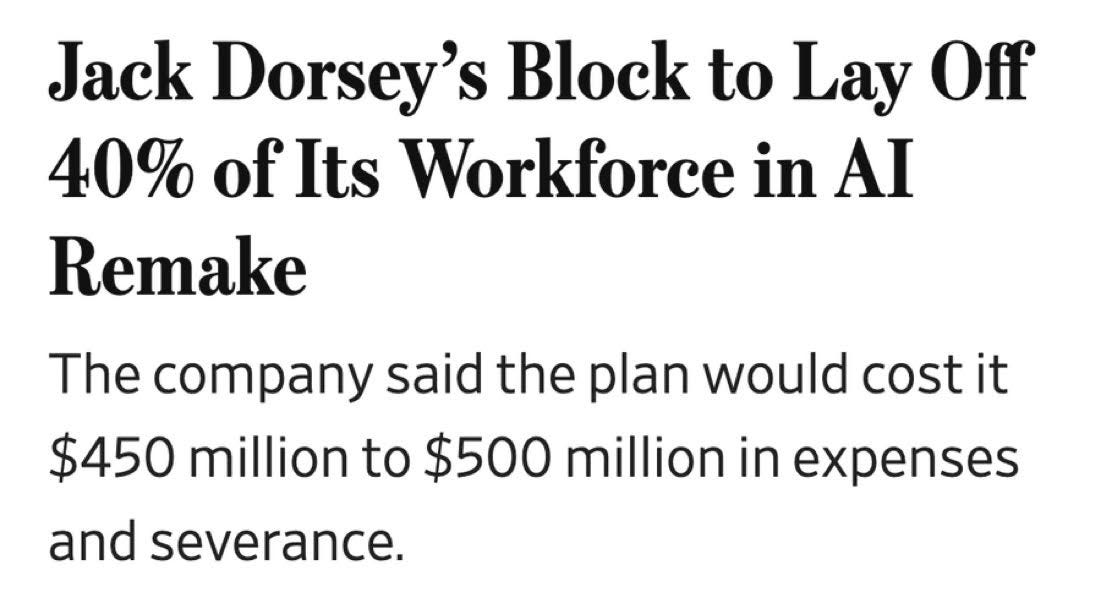
Yesterday, Jack Dorsey, the co-founder of Twitter and CEO of Block (the fintech company formerly known as Square), published a letter to his employees and shareholders announcing that Block was eliminating over 4,000 positions, roughly 40% of its workforce. Dorsey’s letter was blunt:
Today we’re making one of the hardest decisions in the history of our company: we’re reducing our organization by nearly half, from over 10,000 people to just under 6,000. That means over 4,000 of you are being asked to leave or entering into consultation.
Normally layoffs of that magnitude are signs of a company in distress. But Block’s share price surged 24% on the announcement. Dorsey insisted the decision was not born of financial desperation:
We’re not making this decision because we’re in trouble. Our business is strong. Gross profit continues to grow, we continue to serve more and more customers, and profitability is improving.
So why did Block suddenly downsize? Because, Dorsey says, AI has changed the game:
Intelligence tools have changed what it means to build and run a company. We’re already seeing it internally... A significantly smaller team, using the tools we’re building, can do more and do it better. And intelligence tool capabilities are compounding faster every week.
His letter ends with an ominous warning:
Within the next year, I believe the majority of companies will reach the same conclusion and make similar structural changes. I’d rather get there honestly and on our own terms than be forced into it reactively.
AI skeptics have, of course, pushed back on this claim. Will Slaughter, a former Block employee with a name worthy of a 1990s Frank Miller anti-hero, argued on social media that the layoffs were less about AI and more about trimming the fat from pandemic-era over-hiring.
That’s fair enough. There probably is a pretextual element in the current wave of AI-driven layoffs. Perhaps they are even being used to cleanse some of the excesses of the DEI era without triggering a progressive backlash.
But is it entirely pretextual? Is it just trimming fat? I don’t think so. AI-driven job loss seems like a real, indeed accelerating, trend.
This Isn’t the Acceleration We Asked For
According to Challenger, Gray & Christmas, a leading labor market analytics firm, companies in 2025 directly cited AI in announcing over 55,000 job cuts in the United States. That figure is more than twelve times the number of layoffs attributed to AI just two years earlier, and it is almost certainly an undercount, since the tracking relies on voluntary disclosure.
The broader picture is worse still. Through 2025, American employers announced over 1.2 million job cuts across all categories, a 58% increase over 2024 and the highest annual total since the pandemic year of 2020. January 2026 alone saw 108,435 announced job cuts, the largest January figure since 2009.
The jobs that are vanishing are not the jobs that futurists told us would go first. Up until recently, the conventional wisdom in TED talks and McKinsey reports was that robots would displace routine manual labor. The assembly line workers, the warehouse floor staff, the long-haul truckers… Those people might lose their jobs. The knowledge workers, the coders, the creatives, they were safe.
That conventional wisdom is now obviously in ruins. The jobs vanishing fastest are precisely the knowledge-work positions that were supposed to be automation-proof: content writers, journalists, graphic designers, programmers, marketing analysts, paralegals, even lawyers. The humans on the Ford assembly line still have their jobs. The humans writing the Ford.com corporate blog do not, or at least won’t for long.
Now, Dorsey predicts that the majority of companies will follow Block’s lead within a year. That seems overly alacritous to me. Organizational inertia and legal risk will slow the process even if the technology permits it. Dario Amodei, CEO of Anthropic, has more cautiously predicted that AI could eliminate up to 50% of all entry-level white-collar jobs within the next five years. That seems more plausible. But even that would be enough to trigger levels of mass employment similar to that seen in the Great Depression.
Either way, Dorsey and Amodei seem to be broadly in agreement directionally, as do most other Silicon Valley insiders. The economics are too compelling to resist. If a company can replace a $120,000 employee with a $200/month or even $2,000/month API subscription, it will. The fiduciary duty to shareholders doesn’t leave much room for sentimentality.
That Silicon Valley tech oligarchs believe something doesn’t make it true, obviously. We could spill another 10,000 words on this topic and not reach a definitive conclusion. If AI doesn’t disrupt the workforce, then all that follows is moot. But let’s accept the trend as real so that we can ask the interesting questions that follow.
If AI eliminates most human labor, what happens to the economy? How can companies earn a profit if no one buys their services? And how can consumers have money if they aren’t laborers?
Disrupting The Circular Flow of the Economy
It is not necessarily the case that an economy cannot function without wage labor. Long-time readers will recall my 2020 essay Solving the Profit Puzzle, in which I explored George Reisman’s solution to one of the oldest problems in economics, the profit puzzle. As I wrote at the time:
In a circular flow model, “the total value of factor inputs must equal the total value of output at nominal prices.” However, if this is true, then “the aggregate profit accruing to entrepreneurs must be zero,” and “if all revenues accrue to owners of production factors, no monetary resources should be left for fresh investment leading to economic expansion.” But this is a difficult notion to accept, because the same Classical Economic theories also claim that “economic growth and the pursuit of profit are the motive force of the economy.” The apparent contradiction gives rise to what is often called “the profit puzzle.”
The puzzle is real, and it paralyzed economic thought for centuries:
Mainstream economists either don’t understand why profit exists or they pretend it doesn’t. If this doesn’t shock you, it should. Every business in America strives for profit. Countless stock trades worth trillions of dollars are made at Wall Street on the basis of profit and loss by publicly-traded companies. And yet economists insist that none of this “profit” exists, or that if it does exist, it’s all very puzzling but largely not relevant to the macroeconomic condition of business.
Fortunately, one economist did solve the puzzle. George Reisman, Professor Emeritus at Pepperdine University, demonstrated in his magisterial Capitalism: A Treatise on Economics that the source of monetary profit is the consumption expenditure of capitalists. I illustrated the solution in my essay with a simple three-firm model:
Firm #1, an Agricultural Business run by Entrepreneur A, spends $2000 on labor to produce $5000 worth of food. To sell what it produces, it spends another $2000 on marketing and distribution of its food.
Firm #2, a Clothing Business run by Entrepreneur B, spends $2000 on labor to produce $5000 worth of clothing. To sell what it produces, it spends another $2000 on marketing and distribution of its clothing.
Firm #3, a Marketing & Distribution Business run by Entrepreneur C, spends $3000 on labor to produce $4000 worth of marketing and distribution services, which it sells to Firms #1 and #2.
Run the numbers. Firm #1’s revenue is $5000 against costs of $4000, for a profit of $1000. Firm #2, likewise: $5000 against $4000, profit $1000. Firm #3: $4000 against $3000, profit $1000. Three firms, all profitable, in a fully circular flow.
Where does the money come from? The total value of consumer goods produced is $10,000. Total wages paid are $7,000. A Marxist wags his finger: “How can the entire capitalist class manage to draw continually $10,000 out of circulation, when it continually throws only $7,000 into it?”
Reisman’s answer is elegant:
Wage-laborers aren’t the only consumers. Capitalists are also consumers. The money they use to consume is the profit they receive from their ownership of businesses, paid to them in dividends, royalties, profit shares, and so on. The “missing” $3000 of food and clothing is paid for out of the profits.
The solution really is that simple. The source of profit in the economy is the consumption expenditure of capitalists.
Reisman’s work shows there is no innate reason why an economy cannot maintain a functioning circular flow in the absence of wage labor. It is entirely possible to have an economy where production earns profits and profits pay for the consumption of the production. In fact, Reisman argues that is how economic activity begins. He writes of the primacy of profit over the primacy of wages in the pre-modern economy. A blacksmith or carpenter who works for himself using his own tools is earning profit, not wages, Reisman holds; wage labor comes later.
But in the economy as it actually exists today, most consumption expenditure doesn’t come from capitalists, but from wage-earners. Workers receive wages; they spend those wages on goods and services; those expenditures become the revenues of businesses; and those revenues are paid out as wages again. Wages are the most important part of the circular flow, they are what keeps the economy spinning.1
Increasing profits cannot sustain the circular flow because profits are concentrated by wealth, and the wealthy have a reduced marginal propensity to consume, e.g. they have more money than they need, so they save and invest it.
This is easy to understand at the limits. If the world had only one person on it, the world’s wealthiest consumer, with access to the entire production of the planet, that consumer simply couldn’t and wouldn’t consume everything that could be produced. What use could he possibly have for all the food, clothing, toys, furniture for 8 billion people? Divide up the ownership of the means of production into 10, 1000, 1 million, or even 100 million capitalists, and the same problem occurs. The scale of our production today requires consumption by billions of consumers.
But if AI replaces the labor of a significant fraction of the workforce, those billions of consumers go away. When wages stop flowing to workers, those workers stop spending. Business revenues fall. B2C revenues fall directly; B2B revenues fall indirectly, as B2C companies buy fewer B2B goods and services. Collectively, the economy contracts. The concentrated profits that accrue can’t maintain the flow.
We can put this in dollar terms to make it concrete. Block’s 4,000 laid-off employees were earning, let us estimate conservatively, an average of $100,000 per year. That’s $400 million annually in wages that will no longer circulate through the Bay Area economy, no longer be spent on rent, restaurants, groceries, childcare, car payments.
Eventually, through indirect pathways, the $400 million in savings will flow to capitalists, perhaps shareholders of Block who benefit from higher profits, perhaps to other capitalists who offer AI services that Block now purchases. Wherever it ends up, it will be in the hands of disproportionately wealthy individuals and institutional investors with lower marginal propensity to consume. Block’s displaced programmers might spend every dollar they earn. The hedge fund manager who profits from their displacement might consume 10 cents on the dollar. The remaining 90 cents goes into his savings and investment, which is to say, into the acquisition of more capital assets that are intended to produce goods for other people to consume.
When you extend this dynamic across the entire economy, you run out of of consumers. The money flows out of the wage-consumption cycle and into the capital-investment cycle. Production soars, at first. Stock prices soar. GDP, measured in aggregate output, soars too. But then the broad base of consumer demand collapses, because the humans who used to be the link between production and consumption have been removed from the chain, and things fall apart. The glut of production leads to oversupply, unsold inventory, deflation, and depression, and it all comes crashing down.
This is not a new problem. It is, in fact, a very old one. Every civilization that has developed labor-displacing technology has had to confront it. There are three basic models for how it can be resolved. Two are historical and one is fictional. Each solves the problem by re-allocating profit back into the circular flow in a way that restores the propensity to consume.
The Republic of Shareholders
The first model is the one that optimistic technologists instinctively reach for: distribute the ownership.
If AI is going to do most of the work, then humans need to own the AI, not as employees, but as shareholders. In this model, every citizen has an equity stake in the productive capacity of the economy. The dividends from AI-driven production replace the wages from human labor. The circular flow is restored, because money flows from AI production to citizen-shareholders and back into consumption. This is Reisman’s primacy of profit made manifest.
The most systematic thinker on this subject is currently David Shapiro, an AI evangelist who has developed a framework for what he calls “Post-Labor Economics.” Shapiro argues that “every job humans do from necessity represents a failure of automation,” and that the solution lies in transforming everyone from laborers into investors in the automated economy. Through broadened equity ownership and what he calls “universal asset tokenization,” people would maintain economic agency by directing capital resources rather than providing labor. The key insight, in Shapiro’s framework, is that citizens in a post-labor economy will need new powers, and those powers will be rooted not in the ability to withhold labor (as in the old union model) but in the ability to withhold consumption and demand.
Shapiro’s vision has a historical precedent, and it’s an instructive one: the early Roman Republic. In the first centuries of the Republic, Rome was a society of citizen-farmers. Each Roman citizen owned a small plot of land, his heredium, which he worked with his own hands, perhaps supplemented by a few slaves. The citizen’s economic independence was the foundation of his political independence. He could afford to serve in the militia because he had land to come back to. He could vote his conscience because no patron controlled his livelihood. The Republic functioned, in the deepest sense, because its citizens were owners, not dependents.
In this analogy, AI plays the role of the slave. AI becomes the labor force that does the actual work. The equity stake plays the role of the heredium, the productive asset that gives the citizen an independent claim on the economy’s output. If we could distribute ownership of AI capital as broadly as the Roman Republic distributed land, the result might be something like a high-tech yeoman republic: a society of citizen-shareholders, each drawing a livelihood from their stake in an AI-driven economy, each retaining the economic independence that is the prerequisite of political freedom.
It’s an attractive vision. It’s also, unfortunately, the least likely. We know this from history. Over time, wealth tends to concentrate in fewer and fewer hands.
The Digital Grain Dole
The Roman Republic did not remain a republic of citizen-farmers. As Rome conquered the Mediterranean, it acquired vast territories and vast numbers of slaves. Wealthy Romans consolidated these into enormous slave-worked estates, the latifundia, great plantations that produced grain, wine, and olive oil at a scale and cost that no small farmer could match. The citizen-farmers, unable to compete, were driven off their land and into the cities. Rome filled with a growing population of dispossessed citizens who owned nothing, produced nothing, and had no way to earn a living.
The Roman response was the annona, the grain dole. Free grain, later supplemented with free olive oil, wine, and pork, distributed to any Roman citizen who showed up to collect it. By the late Republic, roughly 200,000 Romans, perhaps a third of the city’s population, were on the dole. The poet Juvenal gave this arrangement its immortal name: panem et circenses. Bread and circuses.
If AI ownership concentrates in the hands of a few large technology companies, they will develop into digital latifundia. The productive capacity of the economy will soar, but the gains will accrue overwhelmingly to the owners of the AI systems. The displaced workers, like the dispossessed Roman farmers, will find their labor has no value. They will be no more be able to compete with AI than a smallholder with a wooden plow could compete with a slave-worked estate of ten thousand acres. But without labor they will have no wages; without wage-driven demand, companies will have no outlet for their production.
The political response, in this scenario, will be some form of Universal Basic Income, effectively a modern-day grain dole. The government will tax the AI-owning companies (or their shareholders) and redistribute the proceeds to the displaced population. The citizens will receive enough to survive, perhaps even enough to be comfortable. But they will be dependents, not owners. Their livelihood will come, not from their own productive capacity, but as a political entitlement.
This is, I believe, the path we are currently on. It requires no radical restructuring of ownership. It requires no political will beyond the ordinary democratic impulse to give people money. It is the path of least resistance, which is precisely what makes it the most dangerous.
The Roman grain dole, once established, proved impossible to revoke. It became a permanent feature of the political landscape, and it transformed Roman citizens from independent yeomen into a client population whose political engagement consisted of demanding more generous distributions. The Republic did not survive the transformation. What emerged in its place was an autocracy that purchased the loyalty of the masses with bread and spectacle while real power concentrated in ever fewer hands.
In my essay Techno-Feudalism and Digital Serfdom I argued that contract law’s presumption of equality enables a new form of serfdom when one party to the “contract” is a trillion-dollar platform and the other is a small business that can be destroyed with a single policy change. The grain dole scenario is techno-feudalism’s logical terminus: a society in which the masses own nothing, produce nothing, and depend entirely on the largesse of a digital aristocracy, mediated by a state that serves as the aristocracy’s administrative arm.
The Matrix with a Paycheck
There is a third possibility. It’s speculative; it’s never been tried before in human history. Indeed, it comes to us, not from history, but from science fiction.
In the cinematic release of The Matrix, the machines use human beings as batteries, powering their industry with our body heat. This was rightly ridiculed as an absurd violation of thermodynamic law. In the original script for The Matrix, however, in the glorious first draft before the studio demanded the Wachowskis dumb everything down, there was no such absurdity. The machines didn’t use enslave us for our bodies. They enslaved us for our minds!
In the original conception, the machines enslaved humanity because human brains were creative processors, capable of unpredictable non-algorithmic cognition that the machines could not replicate. The humans were kept alive and dreaming because their minds produced the genuine novelty that the machines could not. The Wachowskis had probably read a lot of Roger Penrose books.
The Wachowskis couldn’t have known it at the time, but they were on to something. In 2024, a paper published in Nature entitled “AI Models Collapse When Trained on Recursively Generated Data” demonstrated what the researchers call “model collapse,” the phenomenon in which AI models trained on AI-generated data progressively degrade, losing coherence and accuracy with each generation. The models need fresh human data to maintain their capabilities. They need the messy, idiosyncratic, occasionally brilliant outputs of actual human minds navigating actual human experience.
Human-generated data is becoming scarce, at least in comparison to synthetic data. In April 2025, an estimated 74% of new content on the open web was AI-generated. It’s almost certainly a higher percentage now. The well of clean human training data is being poisoned, and the poison is the AI’s own output. The models that are so eagerly replacing human workers are simultaneously destroying the substrate they need to function.
The phenomenon of model collapse implies a peculiar economic dynamic. In an AI-driven economy, the scarcest resource might end up being, not compute, not energy, not capital, but authentic human data. And if human data becomes the scarce resource that makes the entire system function, then it seems proper that humans should start getting compensated for it. That leads to the concept of a “data dividend,” an economic model in which individuals are paid for the value their data contributes to AI training and operation.
The data dividend scenario is, quite literally, the Matrix with a paycheck. In this model, humans are valued not for their physical labor (the machines do that) and not even for their intellectual labor (the machines do that too). They are valued for their capacity to generate authentic experience, novel thought, creative output that cannot be produced algorithmically. The machines need human data the way the Wachowskis’ machines needed human minds, not as a power source, but as the one cognitive resource that cannot be synthesized.
How would a data dividend system work? Would it be a voluntary exchange, in which humans are fairly compensated for the value they provide? Or would it be an extraction, in which human experience is harvested and monetized by platform companies while the humans themselves receive nothing, or at best a stipend that keeps them docile and consuming?
The most articulate proponent of a data-based economic vision is Jaron Lanier, a computer scientist and virtual reality pioneer, who laid out a functioning framework for data dividends over a decade ago in his 2013 book Who Owns the Future? Lanier’s core insight was that digital information is, at bottom, human in origin. As he put it: “Information is people in disguise, and people ought to be paid for value they contribute that can be sent or stored on a digital network.”
Lanier proposed a system of micropayments in which every time a piece of human-generated data contributed value to a networked service, the person who generated it would receive compensation. His diagnosis was prescient: “When only certain privileged players can own capital while everyone else buys services, markets consume themselves.” Without compensation for data, Lanier warned, the middle class would be hollowed out from within, its economic function absorbed by what he called “Siren Servers,” the great data-aggregating platforms that profit from information contributed by millions while returning nothing to the contributors.
That is not to say that Lanier has all the answers. He doesn’t. Lanier was writing before the rise of AI, before 74% of the open web had been swallowed by AI-generated assets. He was focused on Facebook profiting from the memes we make, not on OpenAI profiting from the accounting software ChatGPT makes. But his framework anticipated the problem with remarkable precision and could be built upon.
Is there Life After Labor?
Which, if any, of these futures will manifest? It’s too soon to say.
A broad distribution of AI equity is perhaps the most desirable and the least likely. It requires a political and economic restructuring that no powerful interest has any incentive to support. Even if it came about, history suggests it wouldn’t last. Inequality reappears over time.
A digital grain dole seems both the most likely and the most dangerous. It is easy to implement, politically popular, and historically catastrophic. Every civilization that has adopted it has seen its citizen class degrade from producers to dependents, and its political system degrade from republic to autocracy. For our ruling class, of course, that might be a feature and not a bug.
A data dividend is interesting but most uncertain. It depends on a theoretical framework (model collapse means human data is an essential factor of production) that may or may not remain valid as AI improves. It requires a legal and institutional framework that does not yet exist. It might preserve something of human economic agency, because we’d be paid for something we produce rather than given charity, but it might also create a Wachowskian dystopia.
It’s entirely possible we’ll stumble into some ugly hybrid of all three: a distribution of AI profits among the managerial classes, a digital grain dole for the masses, and a data dividend just sufficient to enrich a caste of algorithmically blessed influencers and give the rest of us enough hope of advancement that we don’t revolt.
Whichever future(s) manifest, there remains one final question. What happens to the human need to work? Not the economic need, but the existential need to exercise our capacities in a productive way.
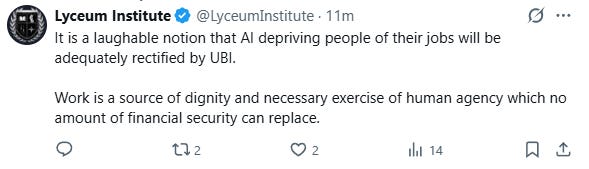
Aristotle wrote that man is a zoon politikon, a being whose flourishing requires purposeful activity in community with others. As in most things, I agree with Aristotle. But we should be careful not to confuse purposeful activity with wage labor. The former encompasses much more than the latter.
We rightly condemn slave societies for holding slaves, but we do not need to condemn the citizens of such societies for failing to find their meaning in drudgery. In ancient Greece and Rome, throughout the Middle Ages, and as late as the Jeffersonian era, the ideal of citizens or aristocrats whose independent holding of wealth-generating property enabled them the leisure to pursue politics, philosophy, soldiery, art, and music was held in high regard by many cultures. The classical tradition did not define the good life as labor. It defined the good life as what a free person does when liberated from labor. We do not need to accept wage labor as our source of meaning.
And yet the citizens of the late Roman Empire who received the grain dole did not, from what the primary sources tell us, seem to be held in the same esteem as the citizen-farmers of the early Republic. Nor do they seem to have held themselves in such esteem. Leisure arising from the ownership of wealth-producing assets seems to be psychologically validating in a way that leisure (or subsistence) arising from government-provided benefits does not.
The citizen-farmer whose slaves worked his heredium while he served in the Senate was a figure of dignity. The urban plebeian who collected his grain ration and spent the afternoon at the Colosseum was a figure of contempt. Both were free of manual labor. The difference was that one was an owner and the other was a dependent. History has already proven that the phrase “you will own nothing and be happy” is a lie.
Social credit theorists, such as Major C. H. Douglas, have argued that the circular flow is already broken in financial capitalism. For a fuller discussion on that topic, I refer the interested reader to my essays The Forgotten Prophet, The A+B Theorem and Social Credit and Monetary Circuit Theory.
A great deal of the current commentary about artificial intelligence “destroying jobs” & somehow threatening to break the circular flow of the economy rests on a remarkably Optimistic reading of what is actually taking place in the real, physical world, because the layoffs that people are pointing to in the technology sector & across white-collar industries aren’t primarily the result of some sudden technological singularity in which machines have abruptly rendered human labor obsolete, but rather the very predictable unwinding of a decade-long financial & organizational distortion that was created during an era of near-zero interest rates, cheap energy, & thus... effectively free capital, when companies (especially in the tech sector galore) were incentivized to expand their payrolls far beyond what underlying productivity or long-term economic fundamentals would justify. When money costs nothing & investors reward growth above all else, firms accumulate entire internal ecosystems of analysts, consultants, product managers, brand strategists, communications teams, culture officers, & other nonsensical layers of managerial & administrative complexity that can exist comfortably only in a world where capital is abundant, energy is relatively cheap, & demographic growth ensures a continuously expanding consumer base; but once those background conditions begin to shift, those layers of complexity become economically fragile & are quickly pared back, which is precisely the process we are witnessing now! 😉
At the same time, the deeper macroeconomic reality unfolding across the developed world points in almost the exact opposite direction from the fashionable AI-technophilia narrative, because the fundamental structural problem facing advanced industrial societies isn’t an excess of workers whose labor can no longer find productive use, but rather a steadily intensifying shortage of them driven by demographic collapse (Japan is a textbook case of this), as birth rates across Europe, North America, & East Asia have fallen far below replacement levels & working-age populations are beginning to contract even as the number of retirees continues to rise, producing the peculiar situation in which fewer & fewer workers must support larger & larger dependent populations. In that context, automation & advanced computational tools function less as destroyers of labour than as compensatory mechanisms designed to maintain economic output in the face of a shrinking labour pool, effectively substituting for workers who were never born rather than displacing masses of existing workers who suddenly have nothing to do... & these tools are just a Zombie & a Dead Man Civilization's way of delaying the inevitable... akin to how a dying man may yet live a few months longer with some chemo! 😘
More fundamentally still (& this is the level of analysis that much of the popular discussion simply ignores)... the economy doesn't ultimately run on abstractions like “labor” & “capital” in the way simplified textbook models suggest, but rather on the far more basic foundations of energy flows, material throughput, ecological capacity, & demographic structure, because every complex economic system is in the end a physical system embedded within the biosphere, dependent on the availability of usable energy, extractable resources, stable ecosystems, & a population structure capable of sustaining the institutional & productive complexity that modern industrial economies require... & when those underlying biophysical conditions begin to tighten (whether through declining energy quality, resource constraints, ecological degradation, or demographic contraction)... the system does what complex systems always do under pressure: Namely, it sheds layers of complexity, meaning that entire categories of bureaucratic, managerial, & low-productivity service work disappear not because a machine has replaced them but because the broader economic structure that once sustained them can no longer be maintained at the same scale:
Seen from that perspective, the attempt to interpret the current wave of layoffs as evidence that artificial intelligence is somehow undermining the fundamental mechanisms of the economy is less a profound insight than a category error, because it mistakes the most visible technological tool of the moment for the far deeper forces that actually govern the expansion & contraction of complex economic systems; for what we are witnessing isn’t the arrival of a machine economy that no longer needs human beings, but the gradual adjustment of an overextended economic structure to a world of tighter energy margins, more expensive capital, aging populations, & ecological limits that were always going to reassert themselves sooner or later regardless of whether large language models or generative algorithms had ever been invented! 😊 🤭
Tl;dr- Pater OPTIMIST Confirmed! 😊 🤭
I derive much of my sense of purpose from self-employment - building things and remodeling; but also growing more food than I can eat, hunting and fishing, binding books, playing guitar, fermenting alcohol, reading and writing extensively.
Theoretically I would still thrive on UBI, as I could supplement my income in many ways. But for the vast majority of people who spend most of their life with their face in front of a screen, UBI would be devastating to a sense of purpose and agency, destabilizing society.